


- Introduction
- When Will My Land Trust be Eligible for the Extended Term?
- What will an Extended Term Look Like?
- Extended Term FAQs
Staying accredited has many benefits, including gaining an extended accreditation term. After a successful third renewal application, the Commission will award accreditation for a seven-year term, rather than a five-year one. The first land trusts that qualify for the extended term can elect to renew in 2024. The extended term includes a process to safeguard the integrity of the accreditation program while respecting the time land trusts commit to the renewal process.
The decision to implement a seven-year term after the third renewal application (for the land trust's fourth accredited term) was made by the Commission in 2019 after careful consideration and with feedback from the land trust community.
The role of renewing accreditation has always been to maintain public trust in the accreditation seal by ensuring accredited land trusts continue to meet national standards. Having a seven-year term after third renewal will create a balance between the time invested by land trusts in the renewal process and the role of renewal in minimizing risks to the land trust community.
2006: The Land Trust Alliance determined a five-year accreditation term best reflects the dynamic nature of land trusts and the land conservation community and was appropriate based on research into similar accreditation programs. It found that while some accreditation programs require annual renewal, and one had a term of ten years, most accreditation programs for groups similar to land trusts have a term of five years. In response to strong land trust feedback, the program was also designed with a single system of accreditation for all land trusts rather than creating tiers within the accredited land trust community.
2010: Prior to designing the renewal process, the Commission evaluated what it had learned about land trusts’ implementation of Land Trust Standards and Practices (Standards). Since many land trusts have to take corrective action to earn accreditation, the Commission determined a five-year term was still appropriate for first renewal. To respond to land trust concerns about the time required for the application process, renewal was designed to have fewer steps and require less documentation than first-time accreditation. On average, renewal requires about one-third less time than applying for the first time.
2014: The Commission evaluated data from early renewal applications to determine whether there could be additional reductions in the application process without reducing the program’s rigor. Unfortunately, the data showed many accredited land trusts had significant gaps in implementing the Standards over their first accredited term. There was no correlation between the gaps and how old the land trust was or the number of staff it had. Based on the data, the Commission announced the first term of accreditation would remain at five years and it would examine the issue again after the next revision of the Standards.
2017/2018: The Alliance revised the Standards in 2017, and the Commission published the corresponding risk-based accreditation Requirements Manual in 2018. The Commission also surveyed accredited land trusts to get feedback about extending the accreditation term. The results were mixed. Many land trusts responded favorably to a five-year term, especially at the outset. Loss of institutional memory was often cited as a primary reason to keep the term at five years. A large majority supported a longer term at later renewals, noting that conservation work often has to be postponed in order to work on renewal.
2019: The Commission and Alliance made the decision to extend the term of accreditation to seven years at a land trust’s third renewal (15 years after initial accreditation). The decision considered the program’s long-term sustainability and the Standards implementation challenges of renewing land trusts. Approximately 20% of renewing organizations do not meet the Standards and are awarded conditional renewal; there is no correlation with an organization’s size or age. In Spring 2019, the Commission also launched a greatly improved online system for first-time applicants and renewal. This two-phased approach of extending the term and improving the online system responds to concerns about accreditation costs while maintaining the integrity of the accreditation seal and sustaining public trust.
When Will my Land Trust Start Getting an Extended Term?
Any land trust that is applying for its third renewal qualifies for a seven-year extended term. One way to think of it is, has your land trust been accredited for at least 15 consecutive years? If so, your land trust qualifies!

If you're unsure of how many terms your land trust has been accredited, please contact us at This e-mail address is being protected from spambots. You need JavaScript enabled to view it .
What Will an Extended Term Look Like?
The application at third renewal will contain familiar components that your organization has seen in its previous renewal rounds. During the term, there will be an Extended Term Report that will ensure the integrity of the accreditation seal and will help build your fourth renewal application. Let's explore each of the familiar and new areas:
As with your land trust's previous two applications, the focus of the renewal application is on your land trust's activities over the past five years as an accredited land trust. There are no additional sections of the application for third renewal. Please note that while the application has not changed, please ensure that the correct version of the Accreditation Agreement is signed.
Review of your land trust's application for third renewal will be in accordance with the procedures and policies that are already in place for all renewal applications. The same is true for the Commission decision.
Once renewed, your land trust can expect to hear from the Commission at specific times over the seven-year term. Below is an example of activities and communications you can expect and when, but the times for individual land trusts may vary.
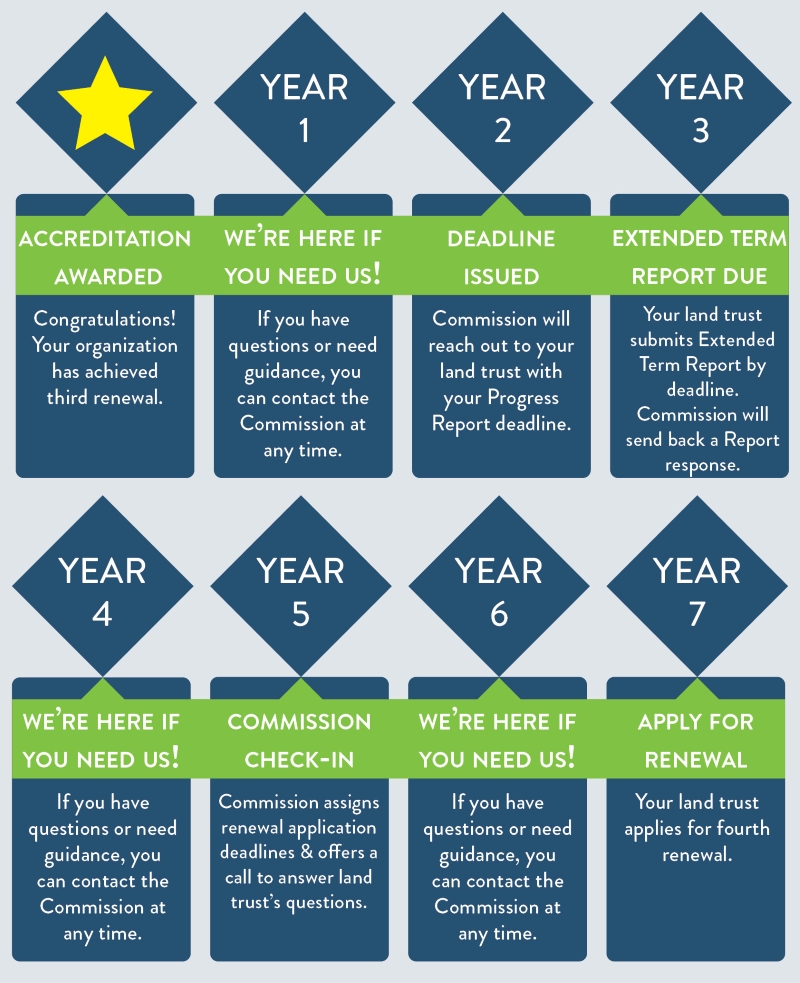
To ensure the integrity of the accreditation seal and to build your land trust's application for its fourth renewal, a mid-term Extended Term Report will be required. The Commission understands that over an accredited term, a land trust and the land trust movement can change. The Extended Term Report requires the land trust to provide a few general updates; the report also provides the land trust the option to submit additional information. Through this report, the land trust and Commission can identify areas the land trust needs to strengthen before submitting its next renewal application.
Download Reference Extended Term Report
- Timing – Generally, a land trust can expect the report to be due in the third year of its extended accredited term. The Commission will contact the land trust about a year prior to give notice of the specific due date. The report must be submitted online via the Accreditation Management System.
- Review of Extended Term Report – The land trust can expect to hear back from the Commission within approximately three months of submitting the report. If the land trust elects to submit the optional information, the Commission will review it and share feedback about any areas where the land trust can take action to strengthen its next application. In the rare event the land trust has a major organizational change not yet reported, the Commission may require additional information.
- Cost for Extended Term Report – There is no additional fee for the Extended Term Report. The accreditation fee is all inclusive. See Extended Term Fee section below, for more information.
The extended term fee is all inclusive, meaning it covers the application review, the Extended Term Report, outreach calls, any consultations over the accredited term with Commission staff, and all other accreditation actions and activities (except appeals).
Application fees for the extended term will follow the same guidelines as previous renewals with the exception that the application fee will be pro-rated to a term of seven years (e.g., a $10,000 fee for five years is $2,000/year; so, a seven-year fee would be $14,000).
Frequently Asked Questions about the Extended Term
We know land trusts may have questions about the seven-year term. Below is a list of general FAQs but if you have specific questions, and would like to speak to someone at the Commission, please contact us at This e-mail address is being protected from spambots. You need JavaScript enabled to view it , we are here to help!
The seven-year term is not optional. This avoids confusion and avoids having a two-tier system where some land trusts after third renewal have a five-year term and others have a seven-year term.
Staying connected with the Commission is easy and encouraged! Land trusts can reach out to staff through our website or by calling the office. Questions about requirements, how to approach an Expectation for Improvement (EFI) or general accreditation questions are always welcomed.
The Commission also has a compliance confirmation policy where a land trust is required to notify the Commission when there are major changes in the organization.
There is no additional fee associated with the Extended Term Report. The extended term fee (due at the time of application) is all inclusive, meaning it covers the application review, the Extended Term Report, outreach calls, any consultations over the accredited term with Commission staff, and all other accreditation actions and activities (except appeals).
The Commission is continuing to shape the guides and materials for the seven-year term. A sample extended term workplan will be issued in the near future.



 It's important to understand when each component of your accreditation application is due.

